Ask what you can drink to reduce inflammation and most people name the same two things: green tea and a green juice. That covers two anti-inflammatory drinks out of a much longer list, and it skips the actual doses behind them entirely.
But only a handful of these drinks have randomized trials behind them, with specific amounts and specific timelines, not just a reputation for being good for you.
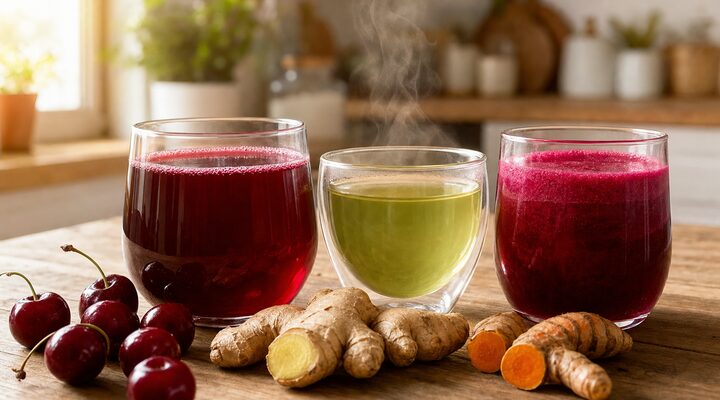
Tart cherry juice and pomegranate juice have the most consistent trial evidence for lowering inflammatory markers like CRP. Green tea, coffee, and beet juice are among the most studied anti-inflammatory drinks, and that scrutiny is exactly why we know their results for inflammation are inconsistent.
Ginger lowers some markers but not others, turmeric works only at supplement doses a latte never reaches, and plain water beats every drink here, not by lowering inflammation, but by replacing the sugary drinks that raise it.
The list below covers each of these, including the dose used in the actual trials:
- Tart cherry juice
- Green tea and matcha
- Pomegranate juice
- Coffee
- Beet juice
- Ginger tea
- Golden milk and turmeric lattes
- Water
The best anti-inflammatory drinks, judged by trial evidence rather than reputation, share one thing: none of them work as a single fix.
What makes a drink anti-inflammatory?
An anti-inflammatory drink supplies the same plant compounds behind anti-inflammatory foods, polyphenols, anthocyanins and nitrates, concentrated into a liquid instead of spread across a plate. Tart cherries deliver anthocyanins whether you eat them whole or drink the juice, and beets deliver nitrate the same way. The difference is concentration, and how easy the compound is to get in a dose close to what a trial actually used.
Why the dose matters comes down to what these compounds work against. Systemic chronic inflammation has been tied to cardiovascular disease, cancer, diabetes, chronic kidney disease, non-alcoholic fatty liver disease, and autoimmune and neurodegenerative disorders, with poor diet named as one of the lifestyle factors that drives it.
None of that shows up as a symptom day to day, which is why researchers track it with blood markers instead, chiefly CRP, IL-6 and TNF-alpha. A drink moving one of those markers in a trial doesn’t mean it moves them for any one person, or by very much. That distinction runs through every entry below.
The drinks with the strongest evidence
Strongest evidence here means these drinks have actual randomized trials behind them, not that the effect on inflammation is large. Green tea, coffee and beet juice are some of the most studied drinks in nutrition research, and that scrutiny is exactly why we know their effect on inflammatory markers is inconsistent.
Tart cherry juice
Tart cherry juice has the most specific dose behind it of any drink on this list: 480 milliliters (16 ounces) a day for 12 weeks lowered CRP in a randomized trial of 37 adults between 65 and 80. Within the group, CRP fell by about 25 percent over those 12 weeks. Anthocyanins, the same pigment behind the cherries’ color, get credited for the effect.
A smaller pilot complicates the picture. A crossover study in 10 adults with overweight or obesity found that 240 milliliters (8 ounces) a day for 4 weeks lowered sedimentation rate, MCP-1 and TNF-alpha, but didn’t move hsCRP at all. Ten people is a small sample, and the two trials used different doses and measured different markers, so the real effect size stays uncertain even with both leaning positive.
Green tea and matcha
Green tea and matcha are two of the most heavily studied anti-inflammatory drinks, and a meta-analysis of 11 randomized trial arms found their catechins had no significant effect on CRP at all. The difference between groups was 0.085 mg/L, with a confidence interval that crossed zero, and it didn’t matter whether the trial ran under 8 weeks or 8 weeks and longer. That’s a null result, not a small positive one.
None of that makes green tea worthless. Catechins do plenty in cell studies, but a cup of matcha in the morning isn’t a lever that reliably moves a blood marker. Anyone drinking it for the taste or the caffeine already has good reasons, and on the trial evidence available, lowering CRP isn’t one of them.
Pomegranate juice
Pomegranate juice has the strongest pooled evidence of any juice on this list: a meta-analysis of 16 randomized trials in 572 people found it significantly lowered hs-CRP, IL-6 and TNF-alpha. That’s three separate inflammatory markers moving in the same direction across more than a dozen trials, a more consistent pattern than green tea, coffee or beet juice can show.
Punicalagins, the polyphenols responsible for pomegranate’s color and tartness, get credited for the effect. The pooled trials used different doses rather than one standard amount, so the practical version is a consistent daily glass rather than chasing a single studied number.
Coffee
Coffee is the most studied drink on this list by participant count, and a dose-response meta-analysis of 11 studies and 61,047 people found no significant association between coffee and CRP overall. Averaged across everyone, coffee doesn’t move this marker in a clear direction.
The three largest studies in that analysis told a more specific story. Coffee was linked to 1.3 to 5.5 percent lower CRP per 100 milliliters in European and American women and in Japanese men, but to a 2.2 percent increase in European men. Which group someone falls into changes what their morning cup is doing, and the averaged result hides that split entirely.
Beet juice
Beet juice’s reputation rests on nitrate improving blood flow, and a randomized, double-blind crossover trial in 27 adults with treated hypertension found that a week of nitrate-rich beet juice didn’t change soluble cell adhesion molecules or circulating inflammatory cytokines at all. Blood pressure and inflammation run through different systems, and this trial measured the second one directly.
Beet juice gets recommended for inflammation almost as often as it gets recommended for blood pressure, and the evidence behind the two claims isn’t the same. Nitrate can still do real things for blood vessels: lowering inflammatory markers over a week isn’t one of them.
Drinks that help less than you think
The drinks in this section carry a reputation that outruns their trial data. Golden milk, ginger tea, bone broth and bottled detox drinks all sound like they’re doing more than the evidence backs up.
Golden milk and turmeric lattes
A turmeric latte works only as well as the curcumin dose behind it, and an updated meta-analysis found curcumin supplements lowered CRP by 3.67 mg/L compared with placebo, at doses of 1,000 milligrams a day or less and in trials running longer than 10 weeks. Doses under 2,000 milligrams a day produced a stronger drop in hs-CRP than higher ones did, so more curcumin isn’t automatically better.
The bigger problem is absorption. In human volunteers, 2 grams of curcumin alone produced undetectable or barely measurable blood levels, while adding 20 milligrams of piperine raised bioavailability by 2,000 percent. Piperine is the compound in black pepper, so a golden milk recipe that skips the pepper skips the ingredient that makes the curcumin usable at all.
Those numbers come from curcumin supplements at measured doses, not from a teaspoon of ground turmeric stirred into warm milk. The latte is a pleasant way to get some turmeric, not the intervention the trials ran.
Ginger tea
Ginger has real trial evidence at the supplement level: a meta-analysis of 16 randomized trials in 1,010 people found it lowered CRP, hs-CRP and TNF-alpha, but not IL-6 or sICAM. Three markers out of five moving is a more mixed result than a flat “ginger fights inflammation” claim suggests.
The caveat is the size of that effect, not its direction. Heterogeneity between the pooled trials was enormous (an I² of 98 percent for CRP), meaning the studies disagreed with each other enough that the true effect size is hard to pin down. Those trials also used ginger supplements, not the cup of ginger tea most people actually drink, so the dose in a mug is a different and unmeasured quantity.
Bone broth
Bone broth has no trial measuring its effect on inflammation at all, which is a different problem from a drink that was tested and came back inconsistent. The collagen and amino acids in a good broth aren’t nothing nutritionally, but the claim that broth lowers inflammatory markers isn’t backed by a study that measured it.
So a bowl of broth earns its place as a source of protein and flavor, not as a drink chosen for what it does to CRP.
Detox waters and apple cider vinegar
Bottled “detox” waters and apple cider vinegar shots share the same problem: neither has a trial measuring what it does to inflammatory markers. A meta-analysis of 9 studies on apple cider vinegar measured lipid profile and glycemic parameters (cholesterol, triglycerides, fasting glucose), not CRP or any other marker of inflammation.
What a lemon-cucumber-mint jug does do is make water more appealing to drink. That’s a real benefit, just not the one on the label.
Why water still beats every drink on this list
Water wins here for what it replaces, not for anything it does to inflammatory markers: plain water hasn’t been shown to lower them. A population study of 2,599 people in Sweden found that higher total water intake was linked to lower triglycerides and higher HDL cholesterol, with no association to HbA1c, fasting glucose, BMI or waist circumference. That study didn’t measure inflammation either, which is worth stating plainly rather than stretching the data.
The argument for water is a substitution argument, not a mechanism one. Every glass poured instead of soda, a sweetened latte or an energy drink is a glass that isn’t delivering the added sugar tied to higher inflammatory markers below.
Juicing versus eating the fruit
Juicing strips out the fiber that whole fruit carries, and fiber is one of the few things in this category with a measured effect on inflammation. Across 14 randomized trials in adults with overweight or obesity, dietary fiber lowered CRP by 0.37 mg/L, and only in the trials where fiber intake ran at least 8 grams a day above the control group’s. That’s a small drop, and it took a real increase in fiber to show up at all.
100% fruit juice still isn’t the same as a sugar-sweetened drink, and juices like pomegranate or tart cherry deserve that distinction. A systematic review with an updated meta-analysis found 100% fruit juice didn’t worsen markers of glucose metabolism and was linked to lower uric acid. That’s a genuinely different result from what soda produces.
The honest middle ground: 100% juice in moderation isn’t the problem sugary drinks are, but it isn’t a substitute for eating the fruit whole either. The fiber that lowers CRP stays in the peel and the pulp, not in the glass. Whole anti-inflammatory foods do that job better than any juice.
What to stop drinking
What you take out of the glass matters more than what you add to it, and four categories of drink work against this pattern instead of for it. Three of them share the same problem: added sugar. The fourth, alcohol, belongs on the same list as the foods that cause inflammation, for reasons that have nothing to do with sugar.
Each one has a straightforward swap.
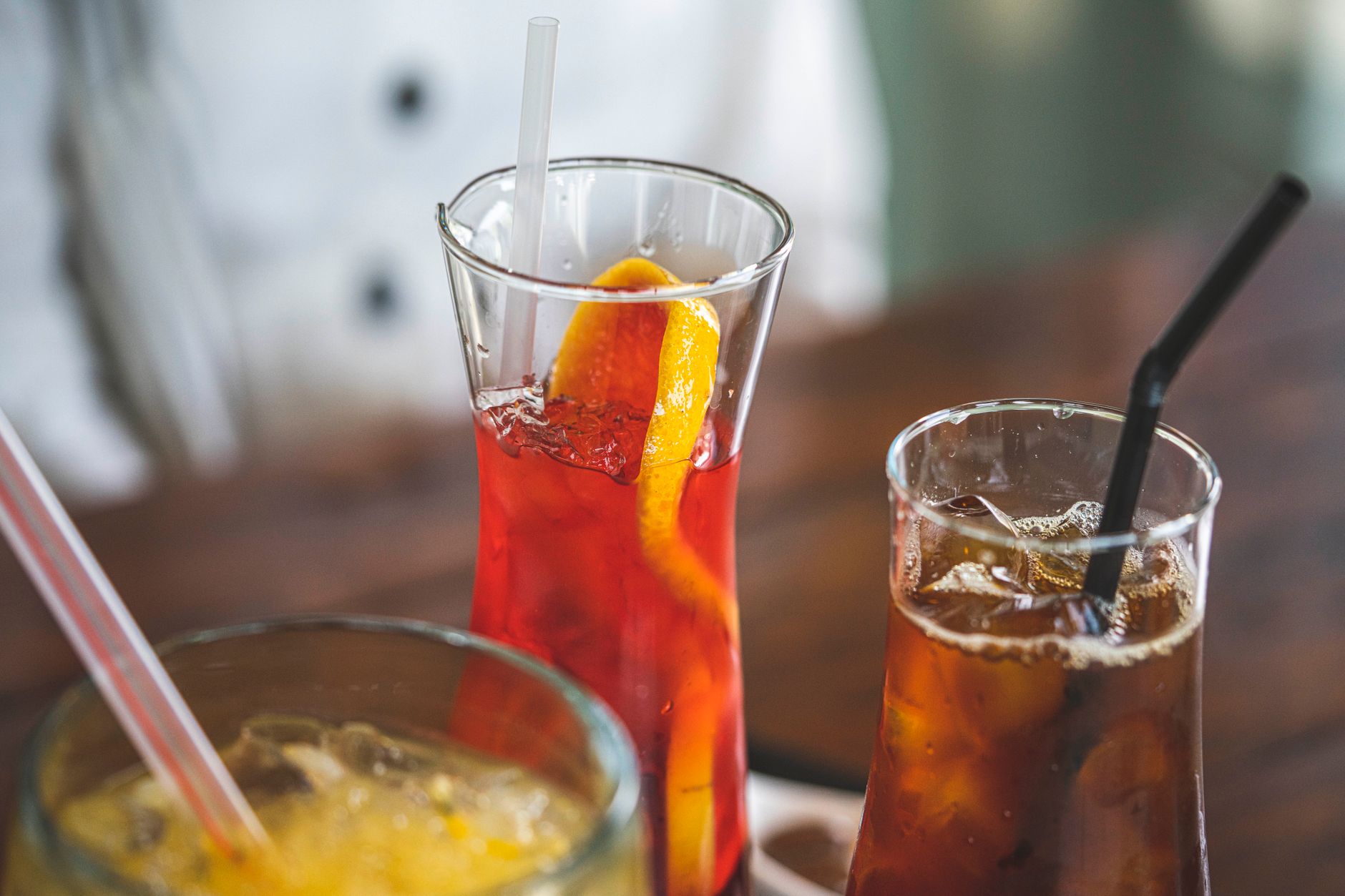
- Sugar-sweetened drinks (soda, sweetened iced tea, sports drinks): a cross-sectional study of 1,128 adults found that people eating a diet high in sugar-sweetened drinks and low in fruit and vegetables carried more body fat and higher CRP, leptin and MCP-1. Swap: sparkling water with a splash of 100% juice.
- Alcohol: it sits outside every drink covered above for a reason, and cutting back on it does more for inflammation than any tea you add. Swap: sparkling water with bitters, or one of the teas above.
- Energy drinks: most run on the same added sugar as soda, plus caffeine at a much higher dose than a cup of coffee. Swap: black coffee or green tea, both covered above with their real trial results.
- Bottled “detox” juices with added sugar: a label that says detox or cleanse doesn’t change the ingredient list, and many of these sit closer to a sweetened juice drink than to the 100% juice discussed above. Swap: the homemade recipes below, which use whole ingredients and no added sugar.
Swapping one sugary drink a day for water or unsweetened tea does more measurable good than adding a golden milk on top of a diet that hasn’t changed.
How much, and how often
Turning this into a shopping list works better with the dose each trial actually used sitting next to what most people pour into a glass or a mug.
| Drink | Amount used in trials | How often | What most people drink |
|---|---|---|---|
| Tart cherry juice | 480 mL (16 oz)/day, or 240 mL (8 oz)/day in the smaller pilot | Daily for 12 weeks (4 weeks in the pilot) | A splash in a smoothie, not a full glass |
| Pomegranate juice | Doses varied across the 16 pooled trials | Daily | A small glass a few times a week |
| Green tea | Catechin doses varied across the pooled trials | Daily, 8 weeks or longer | One cup, occasionally |
| Coffee | Measured per 100 mL of habitual intake | Daily | 1 to 3 cups |
| Beet juice | Nitrate-rich juice, daily | One week in the trial | An occasional glass, not a daily habit |
| Ginger | Ginger supplements, not tea | Trial length varied across 16 studies | A cup of ginger tea, occasionally |
| Turmeric | 1,000 mg/day of curcumin or less, with piperine for absorption | More than 10 weeks | A pinch of turmeric in milk, usually without pepper |
| Water | No inflammation-specific dose measured | Daily | Varies widely |
None of these amounts are a prescription. They’re what the underlying trials tested, which is the detail most lists of anti-inflammatory drinks leave out entirely.
What a drink can’t do
A drink can’t undo a diet built on ultra-processed food and added sugar, however many polyphenols or nitrates it delivers. Every trial above measured one drink added to or swapped into someone’s existing diet, not a diet rebuilt around a beverage.
The effect sizes involved are real but small: a few tenths of a milligram per liter of CRP, a percentage swing in one subgroup. Next to what a whole pattern of eating does over months, they’re a rounding error. A daily glass of pomegranate or tart cherry juice works as one piece of an anti-inflammatory diet plan, not as a shortcut around building one.
That’s also why nobody should expect a drink to fix a symptom. If pain, swelling or fatigue are the reason you’re reading this, a doctor is a better place to start than a juicer.
Anti-inflammatory drinks to make at home
Homemade anti-inflammatory drinks let you control the added sugar that bottled versions often carry, and most take under 10 minutes. A few pair the compounds above with the extra ingredient that helps them work, black pepper alongside turmeric being the clearest example.
- Our anti-inflammatory green juice covers the leafy-green and nitrate angle in one glass.
- The ginger beet detox juice pairs beet’s nitrate with ginger, though a homemade version won’t match the concentrated dose either ingredient used in trials.
- Our lemon ginger shots work as a concentrated, small-serving version of ginger tea.
- The lemon turmeric detox water sits closer to flavored water than to a supplement dose, which is fine for a water swap.
- Our carrot coconut turmeric smoothie keeps the carotenoids that plain turmeric water skips.
- The ginger matcha smoothie works better as a fruity drink with matcha in it than as a dose of catechins.
For more, browse the full recipe collection, or line a week of them up with the meal planner instead of deciding each morning.
Frequently asked questions
What is the strongest anti-inflammatory drink?
Pomegranate juice has the most consistent pooled evidence of any drink, lowering hs-CRP, IL-6 and TNF-alpha across 16 randomized trials. Tart cherry juice comes close behind, with a specific dose (480 milliliters daily for 12 weeks) tied to lower CRP in older adults. Neither does as much as a whole eating pattern built around vegetables, fish and olive oil.
What can I drink before bed to reduce inflammation?
No drink has trial evidence tied specifically to nighttime timing, so the choice comes down to what it replaces. Herbal tea, water or a small glass of tart cherry juice all work as a swap for a nightcap or a late soda, without the added sugar or the alcohol that works against the pattern.
What can I drink to reduce inflammation fast?
Nothing on this list works fast. Every drink above was tested over weeks, 4 at the earliest and 12 or more in most trials, and none reversed inflammation in a single sitting. The realistic version is picking one or two with real trial support, tart cherry or pomegranate juice, and drinking them consistently rather than reaching for one before an event.
Does apple cider vinegar reduce inflammation?
No trial has tested apple cider vinegar against inflammatory markers directly. A meta-analysis of 9 studies measured its effect on lipid profile and glycemic parameters, not CRP or any other marker of inflammation, so the popular claim runs ahead of the evidence that exists.