You finished the elimination phase of the AIP diet. You feel better than you have in months.
Now you miss coffee in the morning or eggs at breakfast.
So you bring back three foods in the same week: eggs on Monday, coffee on Wednesday and black pepper on Friday.
By Saturday, a flare hits. Your joints ache, and your stomach is off.
You can’t tell which food caused it.
Worse, you might cut all three for good, even if only one was the problem.
Testing one food at a time tells you which one is the problem. Here’s how to test each food during AIP reintroduction, how to tell if you’re reacting and what to do if you are.
What is the AIP reintroduction phase?
The AIP reintroduction phase is the second phase of the AIP diet: you bring back eliminated foods one at a time, test each one on a single day, then watch for 5 to 7 days to see whether you react.
Everything on the AIP food list stays the base of your meals while you test.
The testing steps don’t come from a clinical trial: they come from Sarah Ballantyne, PhD, who created the protocol. She lays out a standard challenge that starts with a half teaspoon and builds up over a single day.
When are you ready to start reintroducing foods?
You’re ready when you feel clearly better than you did before starting the AIP diet.
Most people plan 30 to 90 days of elimination before they start testing foods again. Reintroductions are generally best started once your symptoms have improved significantly and are stable.
Hold off on a new test if:
- You have an infection
- You just had an unusually hard workout
- You got less sleep than normal
- You’re unusually stressed
- Something else makes a reaction hard to read, like travel or a new medication
Talk to your doctor or a registered dietitian before you start if one of these applies to you:
- You’ve finished 30 to 90 days of elimination with no clear improvement. Without a calmer baseline, you can’t tell a reaction from a symptom you already had.
- You’re losing weight you didn’t mean to lose. Staying in the elimination phase too long carries a risk of nutrient deficiencies.
For your meals between tests, you can follow a 30-day AIP meal plan or rotate a few easy AIP recipes.
How to test one food, step by step
Each test starts with a tiny amount of one food on a single day and builds up to a normal portion. The steps are the same for every food:
- Pick the food you want to test. Plan to eat it two or three times in one day, then avoid it again for several days.
- Eat ½ teaspoon or less. Wait 15 minutes.
- If you have any symptoms, stop. If not, eat 1 teaspoon and wait another 15 minutes.
- If you have any symptoms, stop. If not, eat 1½ teaspoons.
- Wait 2 to 3 hours, and pay attention to how you feel.
- If you still have no symptoms, eat a normal-sized portion, on its own or as part of a meal.
- Don’t eat that food again for 5 to 7 days, and don’t start testing anything else during that time. Keep watching how you feel.
- If you had no symptoms on the test day or at any point in the next 5 to 7 days, add the food back into your diet.
As an AIP reintroduction chart, one test looks like this:
| When | What you eat | What you watch |
|---|---|---|
| Test day | ½ teaspoon, 1 teaspoon and 1½ teaspoons, 15 minutes apart. A normal-sized portion 2 to 3 hours later | Any symptom during the waits. At the first one, stop |
| Next 5 to 7 days | None of the test food and no other new food | Your usual symptoms, scored 0 to 10 every evening |
| End of the watch | No symptoms: the food goes back into your diet, and the next test can start. Any symptom: stop eating it and wait until you’re back to baseline | Whether your scores stayed at baseline the whole time |

Test the simplest form of the food
A University of Arizona guide to elimination diets recommends reintroducing each food in its purest, single-ingredient form. A mixed dish hides the answer: if you react, you won’t know which ingredient caused it.
That means an egg yolk on its own, not mayonnaise. Beans you cook yourself, not canned beans with added ingredients. Plain cocoa, not a chocolate bar with added sugar.
Which food should you test first?
A 2025 review of the AIP diet notes there’s no rule of thumb for how to start reintroduction. The most common approach is to start with the foods you enjoy most or the ones least likely to cause a reaction.
The AIP reintroduction groups run from least to most likely to cause a reaction. You’ll find them in order in the AIP diet guide.
A few ways to choose:
- Start with foods from the first group that you’d eat often. Testing a food you rarely touch spends a week on information you won’t use.
- Skip foods you don’t miss. Each test you skip saves about a week.
- Test the parts of a food separately. Egg yolk goes before egg white, since they sit in different groups.
- Leave the foods that worry you most for later. By then, you’ll have more practice reading your own symptoms.
How to tell if you’re reacting
Some reactions show up within the first hours of eating a food. That’s why the test day builds in waits of 15 minutes and then 2 to 3 hours.
Other reactions are delayed. A registered dietitian at Ohio State Wexner Medical Center describes a wait-and-see phase of 3 to 4 days after each test food to catch them. The 5 to 7 days of watching in the AIP diet cover that window.
Symptoms to watch for
AIP reintroduction symptoms can show up almost anywhere: in your gut, your skin, your sleep or your mood.
- Digestion: a stomachache, heartburn, nausea, constipation, diarrhea, a change in bowel frequency, gas and bloating
- Energy: fatigue or an afternoon slump
- Sleep: trouble falling asleep, trouble staying asleep or not feeling rested when you wake up
- Mood: anxiety, a harder time handling stress, mood swings or feeling low
- Skin: a rash, a breakout or unusually dry skin
- Aches and pains: in your muscles, joints, tendons or ligaments
- Headaches or dizziness: a headache (from mild to a migraine), dizziness or feeling lightheaded
- Nose, throat and eyes: more mucus or phlegm, a runny nose or postnasal drip, coughing or clearing your throat more often, sneezing and itchy eyes or mouth
- Cravings: for sugar, fat, salt or caffeine
- Your own condition: symptoms of a diagnosed disease coming back or getting worse
Use your own baseline
Pick 3 to 5 symptoms you know well, the ones that flare when your disease is active. Rate each one from 0 (none) to 10 (worst) every evening, starting the week before your first test.
A reaction is a symptom that comes back or rises clearly above your baseline after a test. A high score after a short night isn’t a reaction on its own. Note your sleep, stress, any illness and your cycle next to the scores.
If you can’t tell whether a food caused a symptom, wait longer before testing the next one.
When it’s an emergency
Call 911 and go to the nearest emergency room if you notice any of these after eating a food:
- Swelling of your throat, lips or tongue
- Shortness of breath
- Trouble swallowing
This can be anaphylaxis, a severe allergic reaction. It usually starts with hives or itching. Swelling and breathing trouble can follow within a few minutes, so don’t wait to see if it passes.
If you’ve ever had anaphylaxis to a food, don’t reintroduce that food.
What to do if a food causes a reaction
- Stop eating that food. Don’t push through the rest of the test day.
- Write down what happened and when. Note the food, the amount, the time and the symptom.
- Don’t test anything new until your symptoms are back to your baseline. Testing during a flare can make a new result impossible to read.
- Then move on to the next food on your list.
A reaction can last up to two weeks after you eat the food. So the wait before your next test can take that long.
A failed test doesn’t mean you can never eat that food again. Tolerance can change over time. A food that failed can often be tried again in a few months.
If several foods fail in a row
Talk to your doctor or a registered dietitian. Check whether you tested during a flare or a stressful week. During a flare, it can be impossible to tell which food is the problem.
Staying in the elimination phase long-term carries a risk of nutrient deficiencies. Don’t let it drag on.
Foods that work in small amounts
Passing a test doesn’t always mean a food belongs in your diet every day. Some foods may work fine as an occasional treat but cause trouble when you eat them daily.
Ballantyne’s own example is coffee: even after a successful test, she suggests keeping it as a treat for Sunday brunch rather than a daily habit.
Keep scoring your symptoms in the weeks after a food passes, especially once you eat it more often. If your scores creep up, cut back to an occasional serving.
How long does AIP reintroduction take?
One test takes about a week: a test day, then 5 to 7 days of watching. With no reactions, that’s 4 to 5 foods a month.
Each reaction adds more days. You wait for your symptoms to settle back to baseline before the next test.
AIP diet reintroduction isn’t fast. With one food at a time and no reactions, the timeline looks roughly like this:
| Foods you test | Approximate time, with no reactions |
|---|---|
| 5 foods | 4 to 6 weeks |
| 10 foods | 9 to 11 weeks |
| 20 foods | About 4 to 5 months |
To keep the timeline shorter, test only the foods you’d eat often.
Never test two foods at once. An unclear result means repeating both tests, which takes longer than testing each food on its own.
A sample AIP reintroduction schedule
A sample first month tests one food a week, starting with the first reintroduction group.
| Week | Food to test | Test day | Watch days | Note |
|---|---|---|---|---|
| Week 1 | Egg yolks | Monday | Tuesday to Sunday | First group |
| Week 2 | Green beans (a legume with an edible pod) | Monday | Tuesday to Sunday | First group. If you reacted to the yolks, wait until you’re back to baseline before this test |
| Week 3 | Sesame oil (a seed oil) | Monday | Tuesday to Sunday | First group |
| Week 4 | Egg whites | Monday | Tuesday to Sunday | Second group, only if the yolks passed |

How to track your reintroductions
A simple log turns a confusing week into a clear answer. Write down:
- The food and its form: whether it was raw or cooked and how you cooked it
- The amount and time of each step: from the first half teaspoon to the normal-sized portion
- Your 3 to 5 symptom scores, every evening
- The context: your sleep, stress, any illness, your cycle or a hard workout
| Day | Food and form | Amount and time | Symptom scores (0-10) | Sleep, stress, cycle and illness | Notes |
|---|---|---|---|---|---|
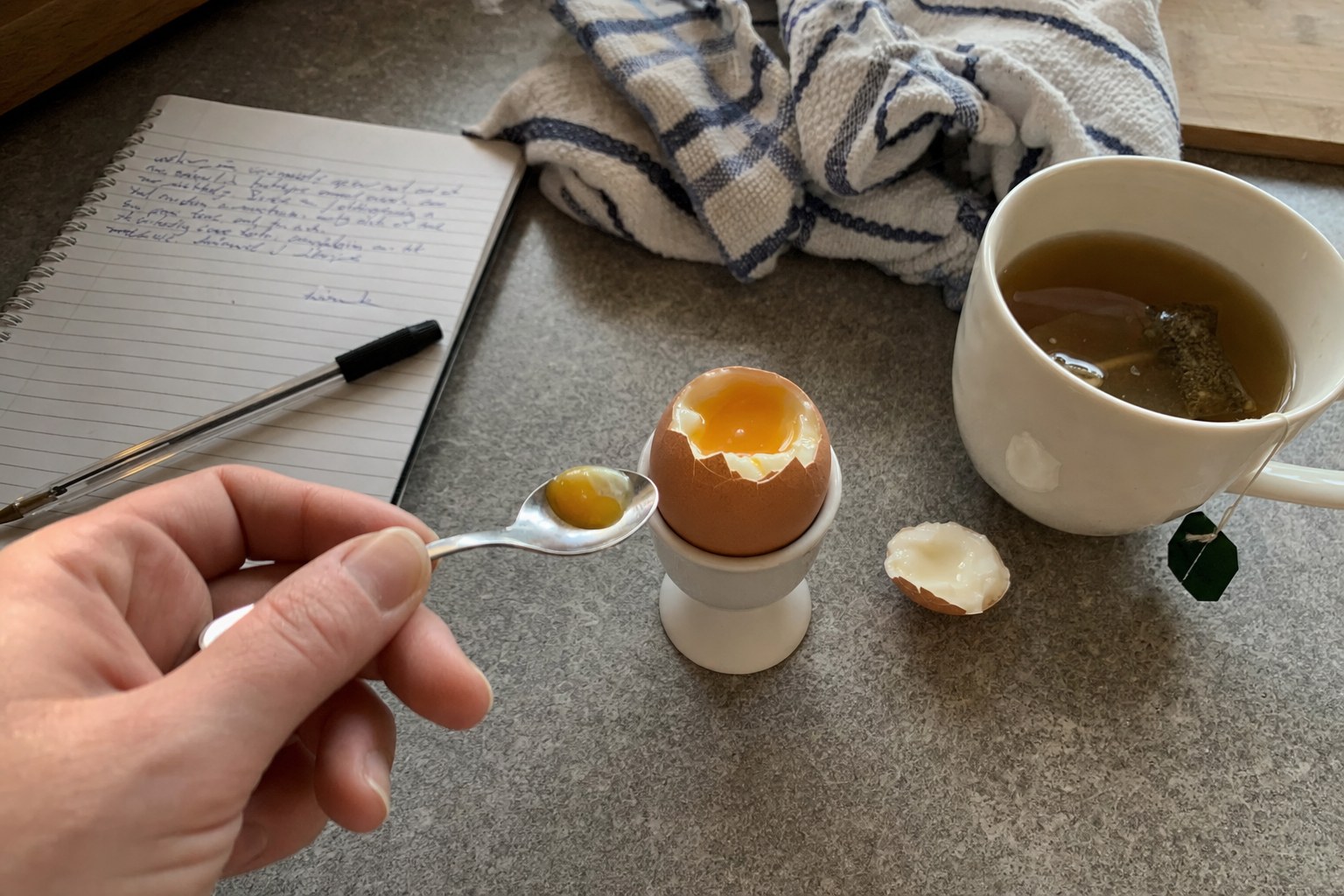
| Day 1 | Egg yolk, soft-boiled | ½ tsp at 8:00 a.m., 1 tsp at 8:15, 1½ tsp at 8:30 and the full yolk at 11:00 | Joints 2, bloating 1 and fatigue 3 | Slept 8 hours, no stress | Scores at baseline |
| Day 3 | Egg yolk (watch day) | None eaten today | Joints 4, bloating 1 and fatigue 5 | Slept 5 hours, up late | Probably the short night. Keep watching |
InflammaScan can take over this part of the process. You log each meal in seconds with a photo or a line of text, and you track your symptoms in the same app.
After 7 days, it shows which foods line up with which symptoms, so you don’t have to match them by hand.
Frequently asked questions
Can I reintroduce two foods at the same time?
No: the AIP reintroduction protocol calls for one food at a time, with nothing else new during the 5 to 7 days you watch for a reaction. If you test two foods together and react, you won’t know which one caused it. You’d have to repeat both tests.
Do I have to follow the AIP reintroduction groups in order?
No: the groups sort foods by how likely they are to be well tolerated, from most to least. You can test a food from a later group before its usual turn, but it’s more likely to cause a reaction. Each reaction adds days of waiting before your next test.
What if I accidentally eat the food again during the test week?
Restart the 5 to 7 day count from the second time you ate it. Don’t test anything new until that new count ends, even if your test day looked clean.
Can I test foods during my period?
You can, but plan around it if your symptoms change with your cycle. Treat those days like a night of poor sleep or an infection. Move the test to a calmer week, when a reaction is easier to read.
Can a food sensitivity test replace reintroduction?
No. According to the Canadian Society of Allergy and Clinical Immunology, no body of research supports immunoglobulin G (IgG) food tests for diagnosing food reactions.
IgG is an antibody. Food-specific IgG marks exposure and tolerance to a food, so healthy people are expected to test positive. The society warns that these tests increase false diagnoses and lead to unnecessary food restrictions.
What comes after the reintroduction phase?
Next comes maintenance, the third phase of the AIP diet. You keep eating the foods that passed and leave out the ones that didn’t. Tolerance can change over time, so failed foods can often be tried again in a few months.