
Ask how to reduce inflammation in the body and most answers turn into a list of foods: more fatty fish, less sugar or a spoonful of turmeric. Food matters, but it’s only one of three levers that move inflammation, and it’s the one most guides stop at because it’s the easiest to turn into a shopping list.
But daily habits and medical care move the same markers, in some trials by more than diet does on its own. Sleep, exercise, body weight, smoking, drinking, stress, an unmanaged health condition and even gum disease all show up in the research connecting lifestyle to chronic inflammation, and several of them are better documented than any single food.
Lowering inflammation in the body comes down to three levers: daily habits with the strongest trial evidence (sleep, exercise, weight, not smoking, limited alcohol and stress management), an anti-inflammatory eating pattern and, when a doctor recommends it, medication.
Of those, daily habits carry the most trial evidence for actually moving inflammatory markers like CRP. Diet is the best documented lever for everyday food choices, and it gets its own section further down because there’s too much to cover in one paragraph.
The eight habits with the clearest evidence, in order:
Food, supplements and medication each get their own section below, once the habits with the strongest evidence are on the table.
What actually causes inflammation in the body?
Acute inflammation is the immune system doing its job: the swelling around a sprained ankle, the fever that comes with a cold. It shows up fast, does its work and fades once the injury or infection clears.
Chronic, low-grade inflammation works differently. It lingers for months or years, usually without a symptom you’d notice day to day, and it runs in the background instead of around one clear injury.
Because it’s silent, researchers track it with blood markers rather than symptoms. Three come up throughout this article: CRP (C-reactive protein), a protein the liver releases when inflammation is present and the one doctors order most often, plus IL-6 and TNFα, two signalling molecules the immune system uses to switch inflammation on.
None of the three is a diagnosis on its own. They’re the yardstick trials use to tell whether something actually moved inflammation, which is why every study below is measured in those terms.
There’s no single cause behind it. Too little sleep, too little movement, extra body fat, smoking, heavy drinking, unmanaged stress and diet all feed the same inflammatory pathways, alongside genetics and, in some people, an underlying condition that keeps the immune system switched on.
That’s part of why no single habit resets it on its own. The levers below all move the same needle, just by different amounts.
The 8 levers that lower inflammation, ranked by evidence
These eight habits are what the trial evidence actually says about how to lower CRP levels, IL-6 and TNFα, in other words, how to reduce inflammation in the body naturally, before medication ever enters the picture. The order below follows the strength and consistency of that evidence, not how often the advice gets repeated.
A lever with a large effect in one small trial ranks behind a smaller effect that holds up across dozens of trials and thousands of people.
Sleep
Sleep has one of the largest bodies of evidence behind it. A meta-analysis of 72 studies in more than 50,000 people found that sleep disruption was linked to higher CRP and IL-6, and that both short sleep and long sleep were linked to higher CRP on their own.
The catch is what counts as disruption. In the same analysis, a few nights of experimentally shortened sleep didn’t move CRP, IL-6 or TNFα at all, which points to sustained, chronic sleep trouble as the driver, not one bad night before a deadline.
In practice, that means protecting a consistent 7 to 9 hours most nights rather than chasing a single perfect night before a blood test. If something disrupts sleep night after night, snoring, insomnia or a rotating shift schedule, that’s the piece worth fixing, since it’s the pattern the research actually ties to inflammation.

Exercise
Does exercise reduce inflammation? The trial evidence says yes, and it holds up even when the scale doesn’t move. A review of 83 trials in 3,769 people found training reduced CRP with a moderate effect (ES 0.26); the effect grew when participants also lost body fat (ES 0.38), but stayed significant even in trials where they didn’t (ES 0.19).
Strength training carries its own evidence, specifically in older adults. Eighteen trials in 539 people aged 60 and up found resistance training lowered CRP with a large effect (ES −0.72), one of the biggest effects on this list, for that age group.
In practice, most trial protocols land near 150 minutes of moderate cardio a week plus two strength sessions. What happens in the gut around a hard workout plays a role too, which is where probiotics and post-exercise inflammation comes in for anyone training at that intensity.
Body fat
Body fat is one of the more consistent levers, and it doesn’t take dramatic weight loss to move it. A review of 76 studies in 6,742 people, most starting around a BMI of 33, found that losing weight lowered inflammatory cytokines in most trials, at an average pace of about 1.1 kg (2.4 lb) a month, over follow-ups from three weeks to two years.
That’s not universal. Three of the 76 studies found no effect at all, a reminder that weight loss helps the average person in these trials, not necessarily every person in them. Losing fat gradually, rather than chasing a crash diet, is what the trial protocols actually followed.
Smoking
Quitting smoking lowers inflammation, but on a longer timeline than most people expect. Tracking former smokers against people who had never smoked, one large study found CRP levels in those who’d quit matched never-smokers within about a year, while white blood cell counts took closer to a decade to catch up.
That’s a wide window, and it’s the part worth knowing before you start. The first marker resets inside a year, so a blood test at the twelve-month mark can already look like someone who never smoked, and the slower markers keep improving for years after that.
Alcohol
Alcohol drives inflammation directly, and the main route runs through the gut rather than the liver alone. Alcohol increases the translocation of bacterial LPS from the gut, a molecule that triggers an immune response once it reaches the bloodstream, and chronic intake wears down the organ functions that normally keep that traffic in check.
The result is systemic inflammation that persists rather than resolving. Heavy or chronic drinking disrupts immune balance and promotes inflammation, and it raises susceptibility to infection along the way.
In practice, this is the lever where less is straightforwardly better, and where cutting back pays off through more than one pathway at once: gut lining, liver and immune signalling all sit downstream of it. If cutting back feels hard to do alone, that’s a reason to raise it with a doctor rather than a sign to push through it privately.
Chronic stress
Managing stress lowers inflammation, but the tools aren’t equally effective, and the one most people reach for first has the smallest effect. A network meta-analysis of 104 trials in 7,820 people compared several approaches against control conditions: cognitive therapy had the largest effect (d=−0.95), lifestyle interventions came next (d=−0.51), and mindfulness had the smallest effect of the three (d=−0.38).
That’s a useful reset on the advice to “just meditate.” Mindfulness still helps, just less than structured cognitive therapy or a broader lifestyle change does in head-to-head comparisons. If stress is the piece driving things, working with a therapist rather than relying on a meditation app alone is what the evidence favors.
Underlying conditions
Some chronic inflammation doesn’t trace back to sleep, exercise or diet at all. It comes from a condition that’s actively driving it: autoimmune disease, an unmanaged thyroid disorder, insulin resistance or an infection that hasn’t fully cleared. In those cases, treating the underlying condition moves the needle more than any lifestyle change can on its own.
There’s no single trial to point to here, because the treatment is different for every diagnosis. What ties this lever to the rest of the list is that ignoring a real medical cause and trying to out-exercise or out-sleep it rarely works, which is part of why a doctor visit belongs on this list, not after it.
Gum health
Gum disease is a more consistent driver of inflammation than it gets credit for. A meta-analysis of 20 trials in 2,561 patients found that treating periodontitis lowered CRP by 0.37 mg/L compared with no treatment, measured one to three months after.
The effect roughly doubled, to 0.75 mg/L, when treatment included antibiotics alongside the standard cleaning. It’s also one of the faster levers on this list: a dental visit and a course of treatment can show up on bloodwork within months, not years, which makes chronic gum disease worth ruling out early.
| Lever | What the trials measured | Size of the effect | How long it took |
|---|---|---|---|
| Sleep | CRP and IL-6 across 72 studies, over 50,000 people | Disrupted sleep linked to higher CRP and IL-6; short and long sleep both linked to higher CRP | Not tied to single nights; short-term experimental sleep loss moved nothing |
| Exercise | CRP across 83 trials (3,769 people); CRP in 18 trials of adults 60+ (539 people) | ES 0.26 overall (0.19 without weight loss, up to 0.38 with it); ES −0.72 for resistance training at 60+ | Trials ran two weeks or longer, with no single pooled timeline |
| Body fat | Inflammatory cytokines across 76 studies (6,742 people, average BMI 33) | Reduced in most trials; 3 of the 76 found no effect | Follow-ups of 3 weeks to 2 years, averaging about 1.1 kg a month lost |
| Smoking | CRP and white blood cell counts in former smokers vs. never-smokers | CRP returned to never-smoker levels; white blood cell counts followed later | About 1 year for CRP; closer to 10 years for white blood cell counts |
| Alcohol | Mechanism reviews on gut permeability, LPS translocation and immune balance | Chronic intake promotes persistent systemic inflammation and raises infection risk | Mechanistic evidence, not a measured before and after timeline |
| Chronic stress | Proinflammatory cytokines and immune markers across 104 trials (7,820 people): cognitive therapy, lifestyle change and mindfulness vs. control | Cognitive therapy d=−0.95; lifestyle interventions d=−0.51; mindfulness d=−0.38 | Measured at the end of treatment, with no single pooled timeline |
| Underlying conditions | Varies by diagnosis; no single trial covers every condition | Depends on the condition and its treatment | Depends on the condition and its treatment |
| Gum health | CRP in 20 trials (2,561 patients) after periodontal treatment | CRP down 0.37 mg/L vs. untreated; 0.75 mg/L when antibiotics were added | Measured 1 to 3 months after treatment |
Where food fits in
Food is the best documented lever on this list, and also the longest one to explain properly. The short version is that the pattern matters more than any single ingredient, and the foods with the most evidence behind them are consistent across the research:
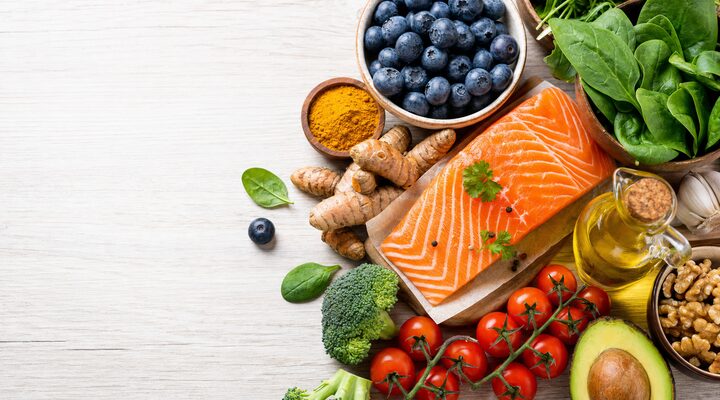
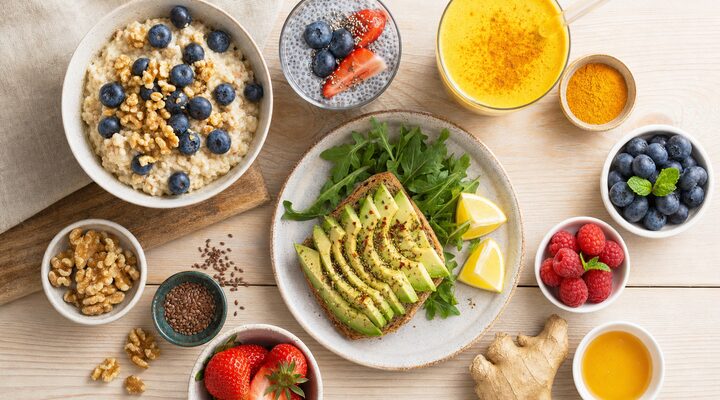
- Fatty fish (salmon, sardines, mackerel): the main dietary source of the omega-3s studied in the trials above.
- Extra virgin olive oil: the fat at the centre of the Mediterranean pattern.
- Leafy greens and colourful vegetables: spinach, kale, broccoli or peppers.
- Berries: strawberries, blueberries and tart cherries.
- Nuts and seeds, especially walnuts and flaxseed.
- Legumes and whole grains: the fibre that feeds the gut bacteria doing part of this work.
- Turmeric, ginger and garlic, though at cooking amounts they contribute far less than the capsule doses used in trials.
On the other side, added sugar, refined carbohydrates, processed meat, fried food and heavily processed packaged food are the ones that push the same markers the other way.
That list is the summary, not the method. For the full pattern, start with an anti-inflammatory diet plan, or go straight to the foods with the strongest evidence and foods that drive inflammation up for the detail on each one.
Anti-inflammatory drinks get their own breakdown too, since what’s in a cup adds up across a day. To turn any of it into meals, our anti-inflammatory recipes and the meal planner handle the planning.
Supplements: what the trials actually show
Look up supplements to reduce inflammation in the body and three names come up again and again: omega-3, curcumin and vitamin D. The trials on all three found real effects, and mostly small ones, which is a different message than the marketing around them usually sends.
Omega-3 has the largest body of evidence. An umbrella review of 32 meta-analyses found omega-3 lowered CRP, TNFα and IL-6, though results varied enormously between studies (I²=89.5% for CRP). If you train regularly, omega-3s and muscle recovery is a related angle worth reading.
Curcumin’s evidence looks similar in shape. A dose-response review of 66 trials found curcumin or turmeric extract lowered CRP by 0.58 mg/L, along with TNFα and IL-6, though IL-1β didn’t move significantly. Those are supplement doses studied in capsules, not the turmeric sprinkled into cooking.
Vitamin D is the honest cautionary tale in this section. In a 4-year trial of 1,054 people, 2,000 IU of vitamin D3 a day lowered hs-CRP by 19% at the 2-year mark, but that difference had disappeared by year four. The same trial’s 1 g/day marine omega-3 arm showed no significant change in any marker at either checkpoint, in the largest and longest trial in this whole section.
Anti-inflammatory medication, and when it makes sense
Medicine to reduce inflammation in the body, mainly NSAIDs (ibuprofen, naproxen, aspirin) and corticosteroids, treats the symptoms of acute inflammation: pain, swelling or fever. It isn’t built or tested as a treatment for chronic, low-grade inflammation, and reaching for one with that goal in mind isn’t what these drugs are for.
The risk profile also varies more between individual NSAIDs than most people assume. A meta-analysis of 25 studies found the risk of gastrointestinal bleeding ranged from an odds ratio of 1.16 for celecoxib up to 20.67 for ketorolac, with ibuprofen sitting at the lower end of the non-selective options (OR 2.28).
That spread means “an NSAID” isn’t one risk, it’s a range, and which one, if any, makes sense depends on the person, the dose and how long it’s taken. Corticosteroids carry their own risks with longer use, and they’re generally reserved for flare-ups of a diagnosed condition rather than everyday use.
None of this is a decision to make alone. If pain or swelling is frequent enough that a medication feels necessary, that’s a conversation for a doctor, not a supplement aisle or a home remedy.
How fast can you actually lower inflammation?
Inflammation doesn’t drop overnight, and most of what promises a fast reset, a three-day detox, a juice cleanse or a 24-hour fast, isn’t measuring anything, because none of it has been tested against the inflammatory markers in the trials above.
The real timelines run slower, and they vary by lever. Treating gum disease is one of the faster ones: CRP moved within one to three months of treatment. Quitting smoking splits into two speeds, CRP caught up to never-smoker levels within about a year, but white blood cell counts took closer to a decade.
Weight loss trials averaged around 1.1 kg a month, following people for anywhere from three weeks to two years before measuring a change. None of these are one-week fixes, even in a best case.
That timeline doesn’t mean nothing happens early. Sleep, exercise and cutting the drivers behind inflammation likely start working before a blood test would catch it. The trials above just didn’t measure day 3 or day 7, they measured months and years, so a one-week reset showing up on paper is a timeline the research doesn’t support.
How to know if it’s working
The marker doctors use to track this is the same CRP from earlier, measured with a more sensitive test: hs-CRP (high-sensitivity C-reactive protein), which picks up the low-grade range that a standard CRP test, built to catch active infection, is too blunt to read.
It isn’t part of a routine checkup by default. Asking a doctor to add hs-CRP to a standard blood panel is how to get a baseline, and it’s worth asking for directly since it isn’t always included automatically.
One high reading isn’t the full picture either. A cold, a minor injury or even a rough night can bump hs-CRP temporarily, which is why doctors generally want it checked more than once before drawing a conclusion. Reading those numbers properly is a job for the doctor who ordered the test, though it helps to know what the usual ranges are and what shifts them. The short version here is to ask for it, and not to panic over a single result.

When to see a doctor
Persistent joint pain, fatigue that doesn’t improve with rest, unexplained fevers or swelling that doesn’t resolve are reasons to see a doctor rather than wait it out with lifestyle changes alone. So is inflammation that shows up on bloodwork with no obvious cause: undiagnosed autoimmune conditions and thyroid disorders often surface exactly that way, as a marker without an explanation attached yet.
None of the levers above substitute for that visit. Sleep, exercise and the rest genuinely move the needle on chronic low-grade inflammation, but they’re not a diagnostic tool, and they won’t catch or treat a condition that needs medical management.
If something feels off and it’s been going on for weeks rather than days, that’s worth a conversation with a doctor before it’s worth another lifestyle change.
Frequently asked questions
How do you flush out inflammation in your body?
There’s no food, drink or supplement that flushes inflammation out of the body the way water flushes out a toxin, and taking that idea literally tends to lead to disappointment. What actually lowers chronic inflammation is a sustained pattern across the levers above, sleep, exercise, body fat, not smoking and managing stress, kept up over months rather than a single detox day.
What are 5 signs your body has inflammation?
Persistent fatigue, joint pain or stiffness, unexplained fevers, skin issues like rashes or redness and digestive changes are common signs linked to chronic inflammation. None of these confirm inflammation on their own, since they overlap with plenty of other conditions, which is why a doctor and a blood test like hs-CRP are the way to confirm it, not symptoms alone.
How to reduce inflammation in 7 days?
A single week won’t undo years of habits, but it can start the swaps that compound over time: prioritizing sleep, adding a daily walk or workout, cutting back on alcohol and treating any gum or dental issue if one exists. None of the trials behind this article measured a 7-day change, so treat a week as a start, not a reset.
How do you treat inflammation in the body?
Treating inflammation starts with identifying whether it’s acute, from an injury or infection and usually short-lived, or chronic and low-grade, which calls for a different approach built around sleep, exercise, body fat, not smoking, stress management and treating any underlying condition. Medication like NSAIDs treats symptoms of acute inflammation; it isn’t a treatment for the chronic kind, and a doctor should guide that decision.